How often do you think about farm workers when you choose your food, cook it, or write about food? Yeah, I thought so. Me too.
Last week I went to a talk about agriculture and social justice by writer Eric Schlosser, author of Fast Food Nation; Greg Asbed, co-founder of the Coalition of Immokalee Workers (CIW); and Lucas Benitez, co-director of the coalition.
Schlosser spoke plainly about how conditions for farm workers have not improved since he took a year to write about the servitude of strawberry pickers for the Atlantic in 1995. In fact, he said, it’s worse now. Minimum wage, adjusted for inflation, is now one-third less than pay in the 1960s and 1970s. And on top of poor working conditions and pay, some states have passed draconian anti-immigration bills that have terrorized farm workers and cost farmers money.
What struck me most about what Schlosser said is how the food movement does not seem to care. As food writers, we’re part of the food movement too. We write about food, farmers, even animals, but we don’t write about who supplies our food. Yet we should be grateful to farm workers for making it possible for us to eat healthy food every single day, he argued, and help them earn a living wage, with decent working conditions.
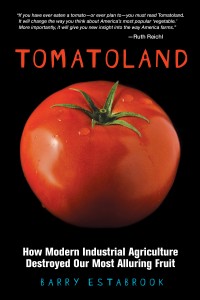
So as food writers, how likely are we to cover this topic, and how does it fit in with the writing we already do? Granted, most of us aren’t going to choose a career as investigative reporters, such as Schlosser or Barry Estabrook. A contributing writer to Gourmet, Estabrook wrote about tomato pickers in 2009, with a provocative subtitle: “If you have eaten a tomato this winter, chances are very good that it was picked by a person in virtual slavery.” I’ve read that former editor Ruth Reichl said one of her proudest moments as Gourmet’s editor-in-chief was publishing that article. Estabrook went on to write Tomatoland: How Modern Industrial Agriculture Destroyed Our Most Alluring Fruit, with an endorsement from Reichl on the cover. If you haven’t read the book, it’s an eye-opening look about how our thirst for tomatoes on burgers creates human misery.
It might be easier to take action outside our purview as food writers. We can educate ourselves on this subject, and it might affect decisions we make. We could ask the farmers at the farmer’s market we frequent about how they treat their workers, for example. Or we might write a letter to Trader Joe’s for not supporting the penny-per-pound increase desired by the CIW.
But if you write about about the pleasures of eating, or if you educate people about the food system and where our food comes from, where does the subject of compassion and fairness for the people who pick our food come in? What is our role?

Thank you so much for this provocative post. This is something I do think about often – and rarely act on. As food writers who write about the pleasures of eating, I do believe it is also our duty to bring attention not only to those who produce our food, but also to those who are without. Again, I must admit that I am all talk right now but I agree with you wholeheartedly that we must be more conscious of where our food comes from on a number of levels. And I do believe that awareness has increased greatly over the past few years, but there is still a long way to go. I’m not sure I’m confrontational enough to ask at the farmers market how they treat their workers (wouldn’t everyone say “great” whether or not that’s true?) but I will make an effort to do more research on the subject and more mindful of it.
That’s super, Katherine. Thanks for taking the time to respond. It will probably take some time to figure out how to talk about the subject, but I am pleased that you are going to think about it and do some research. It makes me feel like I am having an impact, so I wish the same for you.
Thank you so much for writing about this. Most people have no idea how to begin tackling this subject especially because it is difficult to know where to begin or end…most conversations often lead to the fact that the workers are undocumented. But since they are supplying our kitchen tables, our restaurant tables and our children’s school meals with produce, I argue that they have every right to fair wages and fair treatment. I wish everyone was more concious about this very topic, because it seems as though I can never have an honest, informed conversation about it.
You’re welcome, Mariel. The links will provide some good starting points about learning more. The question is how you can broach the subject on your blog, since it is about dessert. Do you see any way to make a connection?
I find that people respond to what is in their own backyard. Luckily, in this area we have access to produce that is so close we can go to it and have it brought to us without it having traveled so many miles, and we can research and know the farm. Focusing on the circle of farm to table as a way of living, has helped me communicate how if we buy our produce locally, it not only ensures quality product, but also allows us to have relationships with the farmers and often, the workers.
I bought pounds of concord grapes to make into sorbet and tapioca and am going to write about the seasonality of these particular grapes. As a sweet blog, I like to tell my readers about what is in season and I think that is a small part in increasing awareness of the farm, the farmer, the worker and the part we play in bringing it to our table.
The problem is getting readers to comment! Any suggestions?
Thanks for the reply.
Sounds good. Please come back and post the link so readers can see how you added the farm workers. Regarding getting people to post, typically people respond when you evoke an emotion in them.
Along the same line, how come more people aren’t writing about the fact that almost all of the chocolate available in this country (with the exception of the companies whose chocolate is fair trade) is produced with the help of child slave laborers in Africa? Because they don’t know? Or because they don’t care?
Probably both of the above. And it’s kind of hard to work into a recipe. Ex. “To make this brownie, find chocolate not made by child slave laborers…”
Dianne, thanks so much for this wonderful post. The thoughtful questions that you pose really resonate with me. I’m a PhD Candidate in the social sciences and have run into a related problem; much of the traditional academic writing that we’re trained to emulate stifles morally driven or activist inquiry. More recently, I’ve started blogging about my research on chocolate (especially the ethics of chocolate), and I’ve found that it offers a chance to experiment with a mixture of food writing, food politics debate, and investigative research like your post seems to prescribe. It’s been a liberating experience and engaging with a dynamic audience is incredibly rewarding. The part that I’m still working on is how to use the short form storytelling format of a blog to tell what are often long, complex stories. And, of course, how to turn something like this into a financially viable work/life…. 😉
Anyways, all this is to say thank you — it’s exciting to read that you’re pondering some of the same issues!
Take care,
Carla, http://www.bittersweetnotes.com
Carla, you’re doing a fantastic job! I think you could be selling some of the pieces in your blog. I love this one on ethical Halloween candy. Great research, very consumer friendly, and not all good news. Fair and balanced.
Dianne, thanks so much for your kind words and advice! Happily, I’ve just had a piece published on The Root entitled Chocolate’s Bittersweet Legacy (http://www.theroot.com/views/chocolate-s-bittersweet-legacy). I should note that your book has provided me with much needed guidance — I still turn to it regularly when looking for answers to questions on food writing.
I also wanted to pass along this 1990 article by Wendell Berry, recently republished, that addresses many of the issues raised in your post and by other comments made here. Berry argues that eating responsibly actually deepens one’s enjoyment of food. “The pleasure of eating should be an extensive pleasure, not that of the mere gourmet.”: http://www.organicgardening.com/living/wendell-berry-pleasure-eating
Hah! I see you’re way ahead of me. Thanks to you for the kind words about my book. And you can never go wrong quoting Wendell Berry.
It’s really important to understand the issues regarding food from several different perspectives; I think food writers in particular tend to choose polarizing points of view. Knowing where your food comes from – not just at the farmer’s market, but also grocery-store products – is one way to make sure your position has balance.
I follow several Twitter, FB, and blogs written by farmers or farm worker advocates. I highly recommend The Rural Blog, a newsletter written out of the University of Kentucky: http://irjci.blogspot.com/
I think there is a lot of writing about where your food comes from, and about farmers. Just not about workers. The Rural Blog looks great, but I did not see anything on that topic when I looked through it just now. Certainly in rural areas there are farm workers. See what I mean? Still, it’s an excellent blog.
As American consumers we are protected so much from the true costs of our food and our food choices.
For example, We are a country of meat eaters since corn subsidies make the per pound price for corn-fed meat unrealistically low. Eating animals fed on corn raised in factory farms brings other problems and “solutions” from meat stuffed with antibotics to pig “waste” farms that pollute whole counties.
Combine this from the “divorcement” most of us have from the food we eat thanks to the marketing and packaging arms of agribusiness and we have a population that is unaware or unthinking about the roots of its food and what is required to get it to the table.
Combine this with the issue of declining buying power for Americans and you have more concern for the price of the food you eat than justice for those individuals who plant and harvest it.
Yes, good points. The price of food has more immediate ramifications for us than the plight of farm workers. BTW, Eric Schlosser did an excellent job on the plight of workers at meat processors in Fast Food Nation.
It’s a little intimidating to be honest Diane, since some of these issues are so complex, and shrouded in layers of PR and other messaging. But you are right and I do intend to write about social justice issues as my blog and my knowledge mature. While I didn’t get into food writing to address the social justice angle, I hope someday I can write about that with the same measured authority as I pour out on waffles and popcorn. What encourages me is that simply rallying people towards local seasonal organics takes us a big step in the right direction, as crops growing in the right place at the right time need less junk which would sicken workers, making high quality for a higher price and better wage. Amen? Thanks for posting – eloquent as always.
-Ryan
Thank you Ryan. Yep, it’s kind of hard to get to farm workers when discussing waffles and popcorn. But maybe you can sneak in a sentence here and there. Ex. I saw that you had a “dirty dozen” post about the produce with the most pesticides. That would have been a perfect opportunity, since farm workers end up getting sprayed with the pesticide and inhaling it, vs. us consuming minute amounts on our produce. Just something to think about.
Yes, my post on Ignore-ganic Produce, or the absence of farming. Will start working it in – Just Do It, as my day-job employer likes to say. And I’ve moved Tomatoland from my should-be-reading list to my actually-reading list – thanks for the nudge!
Any time. It’s a great read.
Many thanks for writing about this! I’m amazed that more food writers/bloggers haven’t become outraged and written about conditions for farm workers. After reading Tomatoland I started my personal boycott of Trader Joe’s ( I was already avoiding my other local supermarket chains). I also wrote about it on my blog. I was particularly indignant at TJs because when I checked their website to read their response to the Immokalee coalition requests, I, a lawyer by training, could barely understand the legalese-couched document. My blog and its reach are small and limited but people did express surprise about the workers’ conditions. Despite this, I have yet to hear of anyone else boycotting and /or contacting Trader Joe’s about their failure to sign on to the requests of the Immokalee coalition. In fact, on a very popular and well read on-line recipe community, Trader Joe’s seems to have lost no popularity and even when another participant and I politely and non-stridently mentioned the subject, noone else even commented. I suspect that most people are reluctant to inconvenience themselves by avoiding a favorite store. Likewise, I suspect that many mainstream bloggers are reluctant to make their readers feel uncomfortable and threatened by their inaction.
it’s a complicated issue. But since our blogs are about us, maybe our personal actions and responsibilities will creep in more. I have been a Trader Joe’s worshipper since the 1970s, but after 2 bouts of pine nut syndrome and now this issue about the tomatoes, I am trying to shop there less. I am weaning myself. And the issue crept into my blog. Why not? It distinguishes you from the millions of other people who aren’t mentioning it.
It might be a bit much to expect the average food blogger to write about the more troublesome aspects of the food industry, but we owe it to our readers to educate and motivate. I work as a freelance writer on top of blogging, and I would definitely investigate any story of local farm worker abuse. I think the trend towards local farm markets and away from supermarket chains and Big Food is a step in the right direction. We get our produce from an organic farm share, and one of the owners was in tears describing how one of her new farm workers, who had migrated from Florida, crawled into a rabbit hutch on her farm when she was showing him around, thinking that was where he was supposed to reside. The only way to propel change in these kind of human rights abuses is to educate the public.
Oh that is a sad story, about the rabbit hutch. But I’m so glad you were even talking to a farmer about the issue. It’s a step. We have to educate ourselves before educating the public.
This is a conversation overdue. I have taken much more care with my seafood due to increased awareness of sustainability – largely from bloggers. I consume far less meat – and I know exactly where my meat comes from due to books and and bloggers and new awareness. So now – with the questions of vegetables and the knowledge that one should be eating a lot more of them – it is imperative to give more thought and care to where they come from – tomatoes are not something I eat out of season – but in Minnesota, one does get tired of turnips and carrots! I don’t have the quick answer – but asking the questions will start me thinking.
Thanks for writing this. I blog about vegan food. Of course, I write about the treatment of farm animals. I care about people too, and this makes me want to explore the subject of the farm worker. I visited Immokalee, Florida, back in the 90’s. The images of the shacks these migrant workers live in are forever stuck in my memory. I haven’t seen such a poor place, not even in Chicago where I live now. I visited Immokalee to deliver food to the poor. Isn’t it ironic that these poor people work on farms.
This is a much-needed discussion, so thanks for bringing it to the table, Dianne. One thing that seems pretty evident is that most people who are really taking a look at their food and its origins are becoming well-versed in organic, local, seasonal produce, and are even looking into small, local farms where they can get their meat and dairy. In short, they’re very conscious of the treatment of animals and plants. But the poor conditions of human workers hasn’t been broached nearly enough, and maybe because it’s “unbelievable” that we could be supporting slavish treatment just by purchasing cans of corn. It’s going to be a resisted topic, but organic food was too, once upon a time.
On an individual level, one way that we can support farmers is by joining a CSA. As it turns out, in my community a CSA did not exist, so I started one with the help of a farm 25 miles away. This has become a service to the community and a service to the farm- by supporting them. We have become too accustomed to eating fruits that are flown in from other countries and have basically been culpable in the poor conditions of foreign farmer workers, because we need our out of season produce 12 months out of the year.
It’s only 50 years ago that our parents were eating what was available and what grew locally. With the onset of industrialization the world has become a much smaller place and we have become much more spoiled.
You are right, Dahlia, that foreign farm workers also face bad conditions, because of our need for produce out of season. Certainly the problem is not limited to the US. But joining a CSA does not necessarily help the plight of farm workers. You would have to ask how the farm treats their workers. I’m not sure anyone asks about that.
Dianne: thanks for raising awareness. Some time ago I wrote an article (in Edible magazine) on coffee and the farmers’ plight.
Oh that’s excellent, Amelia. I hope you write about farm workers here in the US next.
What you andothers are pointing out is that the problem is all over the world, not just here. Last night I spoke with a friend who said she found out that many cashews are picked by prison laborers in Vietnam, and she has been unable to find cashews that are sourced differently, or find out about the source. When you start investigating this stuff it’s horrific!
Dianne: Exactly. The world is small and a lot of our food products come from everywhere. After I wrote the coffee article (and after doing all the research) I feel very strongly about getting only shade grown, bird friendly, fair trade and organic coffee… and there is a price for that: I will gladly pay it, knowing that anything else is exploiting someone (the farmers) or something (the birds, the environment). The same should go for many of the other products we buy. I would rather buy less but better quality and from reliable sources. We need more and constant awareness building of these issues. Thank you for highlighting them and creating a discussion board for all of us.
My pleasure, Amelia. Thanks for your good work.
When my former minister said grace before a meal, he tried to express an “attitude of gratitude” toward everyone who had had a part in getting it to his table — the farmworker who’d picked the produce the farmer who’d raised the animals, the truck driver who’d transported them, the supermarket stockperson who’d put them on the shelves. There’s a whole chain of working people who are responsible for making sure we eat well.
I love that! How insightful of him to think about the whole chain of people, and to pass it on to his followers.
It’s an important and worthy subject to cover as a reporter. Also, often a hard sell with editors and readers. That doesn’t mean we shouldn’t try.
Yes. I was thrilled when Barry announced that Andrews-McMeel had bought his book. I just looked at his sales numbers on Amazon, they’re impressive! And look at the sales of Fast Food Nation! So it’s not all bleak. Maybe a book is the way to go.
Dianne, I feel like much of what I do with my writing IS exactly about educating people about the impacts of their food choices. My post on Barry’s book is just one example. For five years I’ve devoted myself to teaching readers about sustainable seafood with my Teach a Man to Fish event (a virtual potluck and teach-in). I expanded this to include teaching chefs and this year, I’m launching an effort to mentor the next generation of ocean stewards and conscious cooks by directly teaching kids.
I also write about farms and farmers, fishermen and their communities. I wrote a piece on biodiversity and our food choices especially regarding heritage breeds for Good Eater Collaborative. I’ve written about Fair Trade coffee, chocolate and quinoa, as well for my gourmet food column on Suite101.
So I guess my answer to your question ‘what is my role” is that it constitutes a great deal of what I spend my writing life on. Here I am, hiding in plain sight. 😉
Fantastic, Jacqueline. You are not the majority by any means, but you’re doing good work, trying to make changes by educating people.
Thanks so much for bringing up this important point. But I think the argument needs to extend to the 20 million workers who labor in the food supply chain from the farm to the restaurant. For example, food service workers rank with farmworkers as the lowest paid in U.S. Many of the people cooking food — including sustainable, local, gourmet food — aren’t paid enough to afford enough healthy food for their own families. At the same time, unions and worker organizations representing food workers need to do a better job reaching out to food writers and bloggers.
Schlosser mentioned food service workers in his talk. No question that there are lots of horror stories to go around. And most of the people in the food service industry are people of color, just like farm workers. Not hard to make a connection.
Thank you for this, Diane. I’ve been working with a farmworker advocate group here in Portland and have also written about this very thing on my blog. The conditions these folks live in are akin to slave quarters and they are right in your backyard.
We snuck around a bit at the camps so I could photograph the conditions and talk with some of the workers. Needless to say, they were nervous.
There is so much to say on the subject, yet, like you said, it is often (always) ignored. Voting with our dollars will help, but exposing the conditions as much as possible will help more.
Do you know that the reason why these big farms don’t hire American (white) workers is because the conditions are too toxic and dangerous?
Very good, Dina. Readers, if you’d like to read her blog post, here it is.
According to the speakers, farmers do hire American workers, and they are treated just as badly as immigrants.
After the farmers market at the Ferry Building, the farmers donate tons of food to the nearby Occupy SF. Bravo!!!
GAW, a 99 percenter
Okay… That’s great. I’m hoping they were donating it to soup kitchens or Food Runners before, so it’s good work however you define it.
Yes! Yes! This is such and important issue and I’ve never read about it before in the many food blogs I read. I teach Ethical Kashrut (keeping Kosher) at a Jewish Day School and among many things, we discuss the ethical treatment of animals and workers. I will add this book to my reading list. Thank you.
I hope you will add both books, if you have not read Fast Food Nation. It is destined to be a classic. Very nice that you discuss the ethical treatment of both 2 and 4-legged animals.
Like many of your readers, I also believe these are critical issues that need to be addressed. Unfortunately, I’ve found a general lack of interest from “mainstream society” in tackling, or even the simplest desire to understand, some of the most pressing topics. Personally, this hasn’t squelched my own pursuit of awareness and I hope to be able to share the knowledge I’m accumulating with a broader, more interested, audience one of these days.
Well, I think you have to start slowly, Eizabeth. Not hit people over the head but just add a sentence or two into your copy, ex. the next time you write about tomatoes ($.01 cent per pound) or strawberries (toxic chemicals sprayed on workers). I’m all for being subversive.
Yes, I couldn’t agree with you more.
Without having read the previous comments, here’s what I do. I write a monthly column about food for my local paper in Missoula and I co-host a weekly radio show about food on Montana Public Radio. My job is to bring awareness to what’s local and what’s in season and to encourage my readers and listeners to shop at our two fantastic farmers’ markets, where virtually all produce sold is organically grown. I also speak and write about the plight of farmers in many parts of the country and do my best to alert my followers about this grim subject. During the winter months I will not buy a fresh tomato. And I shop and cook as locally and organically as I can. As food writers we need to be vigilant about both the foods we write about and where they come from.
That’s terrific, Greg. I think a lot of food writers do what you do, but they leave off the part about the farm workers.
We’re on the same page, Dianne. I’m finishing up my November newsletter that focuses on this topic. I thought it was especially important to address this issue before people do their holiday food shopping.
Nice. There’s a lot to say about fair trade, boycotting products harvested by slaves/children/prisoners…I wish you luck.
I just thought to let you know that I wrote up a comment for nearly two hours but when I clicked on the submit button I did not realize I was not connected and the entire write-up disappeared into a black hole. I feel awful.
Jayne, you spent nearly 2 hours on a comment? I would feel awful too. Sorry.
Thanks for this, Dianne. It is true that farm worker’s rights is a tough sell. But it’s exciting to see how many of the food writers who have commented here are bringing these issues to their readers’ attention. That wouldn’t have happened five years ago, and I’ll be the first to declare mea culpa. Schlosser is correct, conditions have gotten worse for the people who feed us. The flurry of worker-related articles and blog posts is a postive sign that things can change for the better.
You’re most welcome, Barry. Yes, it’s exciting to see how many people are cognizant of these issues and writing about them. Still the greater food writing community would not think of slipping in a line about toxic chemicals in strawberries while writing a recipe for strawberry shortcake (maybe on their own blog, a line about why to buy organic strawberries in the headnote) and their editors would freak if they did, so we have a long way to go.
Hi Dianne,
Excellent post and discussion here. In mid-October, just after passage of an anti-immigrant bill in Alabama, I read news about how Latinos were literally picking up and leaving their homes, schools and jobs (including the fields) in the dead of night. I was really struck by this and wrote a post about pumpkins and politics. I just wanted to remind readers of precisely your point, that human beings are responsible for the hard work of bringing food to table.
Hope you are well. I owe you an email!
D
Hi Gilda, I’m so glad to read that you wrote about the issue. What a thoughtful post. It’s clear that you put a lot of time into it and drew readers in. I love the close and the photo of your beautiful altar.
The real issue is what do we do about it? Wages are so low that many Americans can barely afford to feed themselves. Many have to work at least 2 jobs to make enough to live on, which means they don’t have time to grow a garden or raise their own livestock. Many also live in areas where they can’t. Not to mention the government favoring Monsanto and big aggro at the expense of smaller more sustainable farms. I think some of these problems would be solved if these issues are addressed.
Remember in the olden days farmers used to have tons of kids who functioned as their slave labor; it’s why we have summer vacation even now. So farming has always required some sort of slave like aspect to keep civilization going. We also now have 7 billion people on Earth, which is really making things difficult. We *can* feed them all, but water is getting frighteningly scarce. I feel it may take an act of God to solve this last problem.
Well, you’ve brought up a lot of topics here. I don’t know if you’re a writer, but what I was suggesting people do about it was to educate themselves and start writing about it to inform readers.
I struggle with this issue, and other issues of social justice related to food, all the time. But I never, ever write about them on my blog. I practiced law for nearly 13 years, and recently finished an MSW while writing a food blog and publishing a gluten-free cookbook. These important issues loom large for me personally. But my blog is fun and lighthearted, as I aim to convince people who have to eat gluten-free that it shouldn’t be expensive or precious – and that they are entirely capable of cooking, baking and eating very well. I am all but certain that, were I to mention any of these issues on my blog, my readership would abandon me. So I dream of being big enough to have a platform durable enough to withstand something more serious.
Thank you for doing what I’m too timid to do myself.
Nicole
Well, I don’t think they would abandon you if you brought it up. I confess that it didn’t occur to me that I could write about the subject here on this blog, and look at all the great discussion it generated!
You don’t have to write an entire post about it, but sometimes there is a way to bring up a serious issue, especially because you are interested in it. You might find it tremendously satisfying. And challenging. Especially challenging!