 Writer and activist Sandra Gutierrez knows what it feels like to be a stereotype, and to break through barriers. She is speaking out through writing — first about food, and now about stereotypes. She did it slowly, but with a belief that her story as a Latina, and the story of Southern Latino food could be told.
Now she’s a nationally recognized food personality, cookbook author, freelance food writer, and cooking instructor. Her articles and recipes have appeared in newspapers and magazines around the world.
The Smithsonian Institution recognized Sandra’s contribution to American culture through an example of community change. Sandra defined the New Southern-Latino culinary movement more than 20 years ago, after she convinced a Southern newspaper that a Latina could manage the food section. Last year the museum put Sandra’s book, The New Southern-Latino Table, her story and some of her cooking equipment on exhibit.
And the kudos keep coming. In October, she wrote about the challenges of writing about Latin food on a Southern newspaper in Oxford American magazine. The piece, “A Voice from the Nuevo South,” won this year’s grand prize for the M.F.K. Fisher Award for Excellence in Culinary Writing. She also wrote “An Africa-American Scholar, a White Southerner from Appalachia, and a New Southern-Latina Walk into a Conference and Grab the Microphone” for the same magazine.
Here’s what Sandra says about perseverance, dispelling stereotypes, and speaking out through writing:
Q. Do you feel like you are an overnight sensation, 25 years in the making?
A. Yes. The longest night of my life!
I feel very blessed. I think if you insist long enough, people listen.
Mine is a story of perseverance. I’m not good at accepting no. I tell myself not now, not yet, not here, but maybe down the road, and that’s what keeps me going.
Q. Who told you to tell yourself that?
A. It’s something I’ve said to myself since I was little. To simply not give up, to find other ways to reach my goal. My parents would say to us in Spanish, “If you want something bad enough, you work for it.”
Q. You wrote about Southern food first, for several years. Then you broke through to write about Latin American foodways. Why was it time?
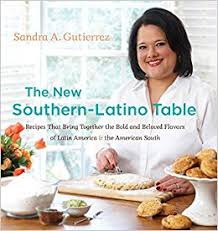
Sandra’s seminal 2011 cookbook about Southern-Latino dishes.
A. It was a matter of dispelling stereotypes. When you live as a stereotype in a society, you either accept the stereotype or you set out to dispel it. Stereotypes are very narrow. One of the most fun and delicious ways to break down barriers is through food. Writing about Latin food became a way to tell people “you’re wrong” without saying it, and “let me show you what’s really out there” without saying so. I am teaching in a fun and gentle way without being preachy.
Dispelling myths about Latin food does two things: it opens up our culinary landscapes to more than just Mexican food, which is just one of 21 cuisines in Latin America. And it showcases the differences between all of those Latin American cultures. We all speak Spanish, but we’re not the same.
Q. Were you nervous when you wrote about your experience on the newspaper? Did you worry about what kind of feedback you’d get now that you were speaking out through writing?
A. Absolutely. So much so, that my editor said to me, “Be brave. I give you permission to say everything you want to say.” I needed that. I didn’t want it to be an angry piece. I wanted to say my truth, but without bitterness or resentment. I don’t feel any of that.
I don’t like to get offended. It’s a waste of energy. You need a thick skin to do what we do because there’s going to be a lot of rejection. I learned early on that I wasn’t going to please everybody. My thick skin has protected me both personally and professionally. Maybe because I don’t accept the “no,” I don’t get offended.
Q. Do you think American society is at a place now where there is more room to hear and read the views of minority women?
A. Absolutely, for several reasons. We’ve been silenced for longer and much more deeply than white women. Once we find that our voices have power, we learn to use them.
Q. Does that frighten people?
A. If you equate being frightened with being angry, then yes.
Q. So that’s why you are not angry or trying to make people angry?
A. My goal is just to state the facts without attacking the reader.
Q. How does your article about the Nuevo South fit into the cultural appropriation charges in food writing?
A. I do not believe anyone can own a cuisine. That is because every single Latin-American cuisine came to be what it is today due to a huge amalgamation of cultures. The evolution of food is organic and unstoppable.
Q. You define yourself as an activist. What does that mean to you, and how does it help you when speaking out as a writer?
A. It’s a new term that I’ve allowed myself to own. I want to use my voice to help future generations of new Latinos in the US, to have it a little easier than we have had. It means something when you know you’re helping other people. In this atmosphere we’re living in right now, which is politically charged against my people, I feel like I’ve earned the right to speak out through my writing.
* * *
You might also like:
- 2 Bloggers Who “Burned It All Down” with Risky Writing
- 8 Techniques for Writing Personal Essay
- Molly Wizenberg: “Let Your Writing Speak for Itself, and Be Proud of It”
(Disclosure: This post contains affiliate links.)
599 × 899

Great piece, thank you Dianne. I admire Sandra Gutierrez for what she has achieved and for speaking out and try to brake those stereotypes. Having lived in different countries for over 20 years now, I often had to deal with being stereotyped. I’ve always been diplomatic but assertive when explaining that you should try to get to know people and their culture better before you make assumptions.
Thank you Maria. So you know what she’s talking about!
It takes courage to speak out. She does so wth respect and tenacity. I am learning from Sandra.
Here’s something else that I think is amazing about Sandra–you wouldn’t know what a powerhouse she is by talking to her. I don’t mean to say that she hides or dismisses her power–just that she’s so friendly and personable and human, and she always makes me feel like I’m the most interesting person in the conversation when the opposite is surely true.
You hit on one of the things that is so impressive about Sandra, Jill. She doesn’t have to shout from the rooftops. Thanks.